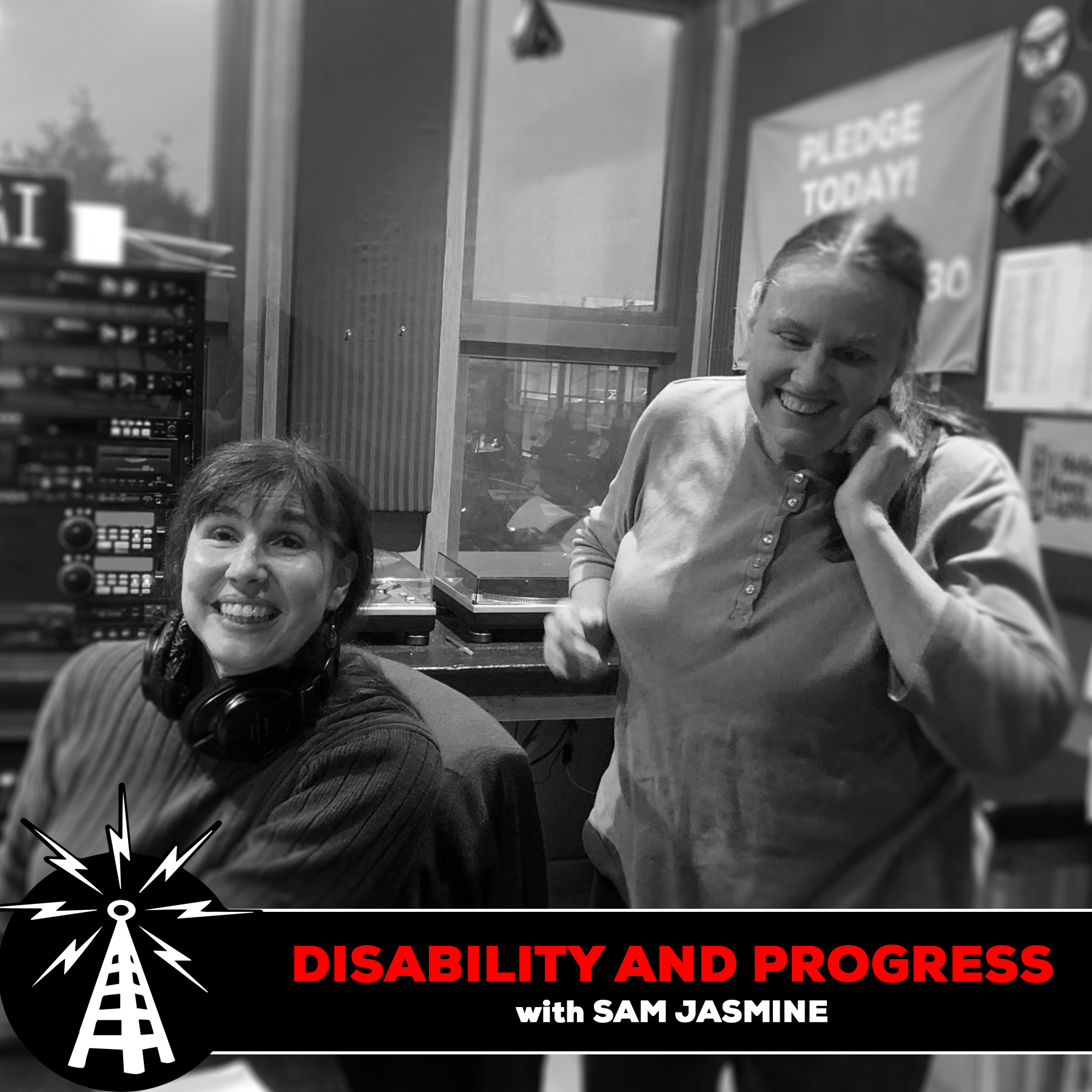
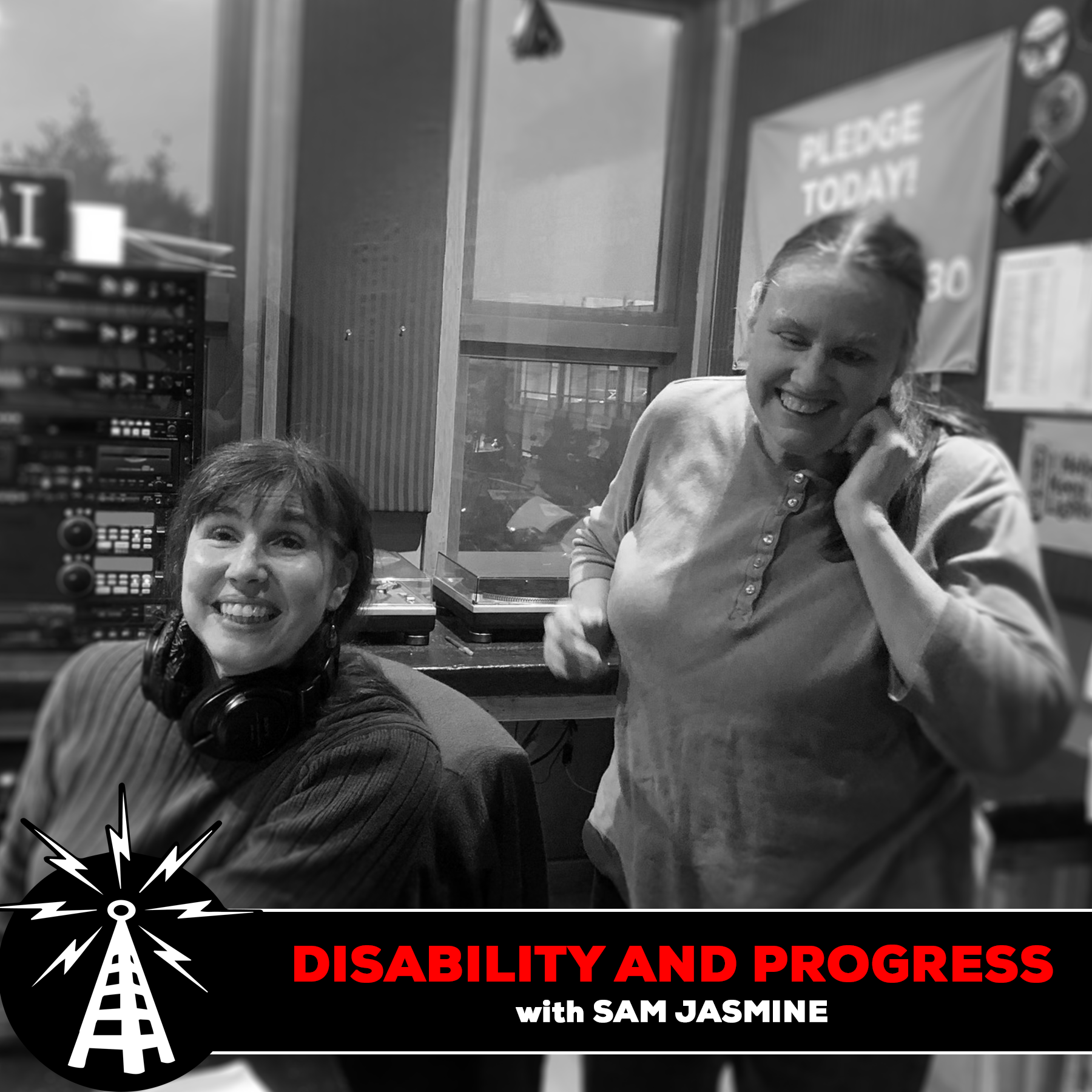
Episode Transcript
[00:00:00] Speaker A: KPI.org.
It.
[00:00:59] Speaker B: Greetings. Thank you for joining Disability and Progress. I'm Sam Jasmyn.
[00:01:05] Speaker A: I'm Charlene Dahl.
[00:01:07] Speaker B: Disability and Progress, where we bring you insights into ideas about and discussions on disability topics.
And thank you to Erin if I don't forget to say it, who is our podcaster?
Want to remind you just a couple things that Disability in progress can be heard on the archives for two weeks.
And we also have a podcast that you can hear us at any time and you can ask your big brother speaker to listen to the latest episode of Disability in progress. And just because I'm pretty sure he doesn't want anyone to know. Happy early birthday to Miguel. Miguel is our program engineer person who works the station.
So happy early birthday, Miguel. Now the world knows. Ha ha ha ha. Anyway, this week we speak with Darian Slayton Fleming. Darian is a happiness coach, a practicing clinical social worker, an advocate, and an author.
She is a deep thinker and a bit of a comedian and a bit of a rebel.
Darian's work is not a job, but it is her calling. She enjoys encouraging people to find their voices, speaking up for themselves to get what they need and feel good about it. She has written two books, her memoir defying death and living an empowered life with multiple disabilities and speak up for yourself, get what you need and feel good about it.
She also produces a podcast called you guessed it, get what you need and feel good about it.
And Darian is a woman with multiple disabilities who doesn't let anything stop her. Darian's wish is that people will hear her story and be encouraged to find strength and joy in the present moment.
Well, Darian, thank you for joining us here.
[00:03:22] Speaker A: And I trust you're hearing me.
[00:03:24] Speaker B: Yes, I am hearing you now.
[00:03:27] Speaker A: Great. Thank you. I'm so happy to be here.
[00:03:30] Speaker B: Well, thank you very much for joining us. And I want to start out. I know I had this great bio on you, but for those of you or those who don't know you, could you give us just a little bit of a history about you up before you know the podcast?
[00:03:51] Speaker A: I as my bio says, I have multiple disabilities. I am legally blind and I have my other disabilities.
I feel all fall under the umbrella of cerebral palsy. Nobody ever told me what I gre.
I grew up navigating my situation along with my parents, my family navigating it. We went through all of this before there was an ada and so I was very fortunate that my mom was such a great advocate for me and she went ahead of me through School, I was mainstreamed and let my teachers know what I needed, and maybe we'll talk more about that. But when I was 2, I had an illness like croup and I was unable to breathe, and my mom got scared and she took me to the emergency room and they admitted me and put me in an oxygen tent. And this was a 1958. So this was before.
Before technology was so advanced, like we know it now. So there weren't monitors in the nurses stations so that they could keep tabs on the patients. Right. And.
And they didn't know CPR then, the way we use it today.
So things started happening that shift changed that day, and as any of you know that have been in the hospital at shift changed, it's time for the nurses to report what's going on, and then periodically they make the rounds and check on the patients.
So when.
So the story that. And I didn't know this part of the story until 2017.
Throughout my life, my family and I have. My mom has always thought that this happened because my pediatrician was not on staff at the hospital.
And the story now is that when the nurse discovered me not breathing, she paged the doctor assigned to me and he said he was at lunch and he would take care of me when he was done.
So.
[00:06:37] Speaker B: Oh, holy smokes.
[00:06:39] Speaker A: So I am very fortunate. I do. I. I do have the gamut of physical disabilities, along with legal blindness. I can see colors and objects and shapes, which is really useful, but I can't read print.
And I always tell people I have enough sight to get into trouble and not enough sight to get out of trouble.
[00:07:07] Speaker B: I've heard that a lot from people.
[00:07:11] Speaker A: So that's kind of the. The beginning of my story. I was mainstreamed throughout school until I was about 12. And I went. I was invited to. I was sent to a summer school session at the Oregon School for the Blind.
And that was the first time I had ever been around other kids who were more like me. We all had vision difficulties, but even there, I felt kind of like the outcast because of my additional disabilities. And, you know, there were things that my parents just didn't have the patience to teach me or didn't know how to teach me.
And I never even learned to tie my shoes till I was 13.
[00:08:06] Speaker B: Wow.
[00:08:07] Speaker A: And I didn't learn to hold a fork correctly until I was 13.
And so I was thrilled to be in a group of kids who were more like me. And actually, one of my first really best friends is. And was Kim Charleston, who was the first president of the American Council of the Blind. First female president of the American Council of the Blind. And we became really good friends. We were roommates one year in college while we were at the school for the blind. She would come home for weekends with me, and I would go home with her.
And I have some funny stories about that, too. But that was the beginning of me really learning what my own capabilities were.
And I've always been. I think I've always been a fighter. I think later in life, I had this little epiphany, and I realized that that fighting spirit within me has probably always been there since I had to hold on for dear life until somebody discovered me at age 2. And I'm still a very strong, passionate, outspoken person, which is a strength and sometimes occurs.
[00:09:46] Speaker B: I'm wondering, when you talk about mainstreaming.
So. So many people that I knew that were visually impaired or blind were not mainstreamed. They were stuck in a school for the blind, like, fairly early in life. And I feel like to be mainstreamed was more unusual.
Do you ever wish that it would have been opposite for you, that you would have been school for the blind first and mainstream after? Or were you happy to have had that first beginning mainstream experience?
[00:10:21] Speaker A: I think I'm happy that I had that mainstream experience.
I didn't realize how different I was. Nobody treated me differently because I grew up in the neighborhood with the kids who knew me from really before we really got into school. So they treated. Nobody treated me differently until I got into elementary school.
Teachers started making a big deal out of it, and I was very fortunate because, of course, I had itinerant teachers, and I learned braille from. Actually, my first exposure to braille was in kindergarten when my first itinerant teacher brought books and trained my finger sensitivity. I had to identify whether what shape something was by touch and whether it was shaded or not. And I think that was designed to help me learn to use my fingers. And in fourth grade, my mom bought me an electric typewriter. One of my disabilities has difficulty with fine dexterity, and she taught me how to type so I could do my own homework.
So I had some wonderful experiences along with being treated as one of the gang.
[00:12:01] Speaker B: Right.
[00:12:02] Speaker A: Especially before I started school.
[00:12:04] Speaker B: I. And I do feel that sometimes there's this social component that gets lost with when you get sent to another school that, you know, isn't for everyone.
And then when you. If you go back, there's. It's a different social experience, learning how to kind of make friends with just anybody or, you know, socially Be accepted anyway. That we probably could have a whole nother show on that. But.
[00:12:37] Speaker A: Right. But I do have something to say about that.
Go ahead.
You know, I. I asked to go to the school for the blind in eighth grade because I. I learned things and I felt accepted. And when.
And my experience, though, we. When we finished ninth grade, we were sent to our local neighborhood high schools.
And that was hard for me, harder than I expected it to be because I think people.
Well, you know, all of the neighboring schools came together in the high school, so there were lots of kids that didn't grow up with me.
And all of a sudden everybody saw me as different and, And I did feel often left out. It was hard to feel accepted when I came back into the school where people used to know me and then they had to get reintroduced to me.
[00:13:57] Speaker B: Well, and you came back in ninth grade. You know, I feel like I don't know what it was for you then, but I was mainstreamed. And I, you know, later, and I feel like, well, if you're in junior high and you're being mainstreamed, the kids aren't really. They're not really human. They're kind of sub. Subhuman.
[00:14:15] Speaker A: They're.
[00:14:16] Speaker B: Kids are mean at that age.
And then in high school, some switch flips and I think they get a little bit more human and. And start acting a little bit nicer and. And you meet different. You know, I think people grow up a little more then. But that's my personal opinion.
[00:14:35] Speaker A: But I was a sophomore when I came back and there were the human kids and, and there were the kids that I could. I would overhear talking about me. And there were the teachers. Yeah, some of the teachers I had in elementary and high school school were more discriminative, I think, than my peers were.
[00:15:04] Speaker B: Right. Yep. Yep. That. That does sometimes happen. And I feel like now kids have. In some ways I feel like they're so fortunate because they have more than.
Than I ever had. I know.
And I feel like. And it's expected.
It's expected. Where I was taught, you should be lucky that they're letting. I'm like, whatever.
That was kind of my attitude. No, they should be lucky to have me.
[00:15:36] Speaker A: Right.
[00:15:37] Speaker B: I'm wondering, you know, when you were growing up, so it sounds like, you know, you were just kind of one of the gang as you were talking about in your neighborhood and your family.
When did you.
Was there a point where you started realizing self advocacy was, you know, that was your life, that was what you were going to have to do.
What, was there a particular experience that triggered you to do that?
[00:16:07] Speaker A: Right. I. I believe that that awareness and that decision to be proactive about advocating for myself really started in college.
And I, I had an opportunity to get a job at my college as a resident assistant. And I was always kind of friends with the resident assistants.
In my freshman and sophomore year at.
I went to what was called Oregon College of Education then and now it's called Western Oregon University.
But I had an opportunity to apply for the resident assistant position, and I was actually ready to transfer to Oregon State University.
But I wanted to see if I could get this job as a resident assistant because I really wanted to start creating a resume for myself. So I interviewed for the job and I actually got it. I'm sure I'm the only blind resident assistant there ever was, at least at that time. And so I ended up working with an advisor and kind of charting what courses could I take at that time that would be transferable to Oregon State University. Because by that time I knew I wanted to transfer to Oregon State to get a degree in child development and family life. So that was a really great experience.
No question that from any of the people who interviewed me, that I would be able to do the job.
And it was a great experience.
[00:18:18] Speaker B: That is nice, isn't it, where they, they are just thinking that, you know, they're making sure you can fulfill the abilities, but they're not necessarily doubting you.
[00:18:31] Speaker A: Right.
But then also when Kim Charles and I and I became roommates in college, we also got introduced to the American Council of the Blind and attending. When I went to my first American Council the Blind convention, it was just mind blowing because I had no idea about the plethora of possibilities and resources.
And we were encouraged to get involved. And that's when I actually started learning how to apply and know the impact that advice, advocacy and self advocacy can have.
[00:19:26] Speaker B: When you were growing up, who did you feel were early influencers on. Yeah. Or mentors for you?
[00:19:35] Speaker A: I have to say that my mom was my mom. My. My mom was even before she realized she was doing it, before I realized what was happening, I was observing.
I listened to her. I would hear her scheduling doctor's appointments, talking to people on the phone, and she then made me learn how to type. And she, you know, we've, we've.
I was a difficult teenager. You know, I've been. I made life hard for her sometimes, but she really was an advocate for me.
I would say another influence in my life was Carol McCarl. When I knew her when I started at the School for the Blind. She was Carol Derwin, and she was the typing teacher.
And she was always very encouraging of me. And there was another teacher, Mrs. Miller, who was the English teacher. And I loved. I love writing, and she was always very encouraging to me. And then the other thing that happened was we got to have experiences that I might not have had otherwise. The gym teacher would take us on backpacking and hiking trips, and that was a challenge for me because of my gait and balance, but they always in included me. And so those experiences helped me realize that I could do a lot of things I didn't know I could do.
[00:21:36] Speaker B: Cool. How.
What made this come about? And why do you think so many people. I feel like there's. Why do you think so many people with disabilities struggle asking for, you know, what they need? But I don't think it's just pertaining to that. I think a lot of people, regardless if they have a disability, struggle for asking for what they need.
[00:22:01] Speaker A: I wrote the book first.
I had an occasion. I got invited to participate in a project called Write a Book in a Weekend.
And so I had a lot of this stuff written already because I had really love teaching communication, and I love just helping people.
It's just natural for me to encourage people. But what I noticed was in our community and in the. In the world in general, when we need something, a lot of us don't persist.
And if we feel shut down, so maybe we make a phone call to ask for something and we don't get our call returned. And then that, to me, I started thinking about that and realizing that's frustrating. It really is. When we try to advocate for ourselves and the systems we're working with aren't everything that they try to make us think they are. And sometimes people don't return our phone calls. And I realized that at the end of the day, if I really want something, it's up to me to persist until somebody listens and they may not give me what I want or what I need. We may have to negotiate or.
Or investigate how this is going to work. But at the end of the day, if I don't persist, it's not their fault that I don't get what I need. And so I thought, I want to write about this. And then the other thing that I discovered is in my work in the American Council of the Blind of Oregon, we were helping people advocate with the Oregon Commission for the Blind, among other people and agencies. And when a person would have a need and it Wouldn't get met.
I would ask them, well, did you document?
And one of the cases I advocated with was somebody who was participating in the Business Enterprise program, and they were taking away one of his facilities.
And I asked him, do you have documentation of when you were given that facility? And he was kind of grandfathered in, and he didn't save the emails. And I really feel that if you document, and even the agency didn't always document.
If you document and they don't, you have sharper teeth.
[00:25:39] Speaker B: Yes.
[00:25:39] Speaker A: And so my book really had three premises. It was persist, take personal responsibility, and document.
And so when I decided that I wanted to be present in the community in a different way, that's when I started my podcast and I actually began that podcast. My very first episode featured part of a speech that my late husband, John Fleming, who was a blind skydiver, gave to the American Council of Blind. And he had three keys that kind of meshed with my keys, and those were be determined, do creative brainstorming and ask for support.
And so I started.
I actually burst that podcast and started, aired the first episode on his birthday, which was April 27th.
And by that time, he had passed away. He had lung cancer twice, and he couldn't beat it the second time. And so I wanted people to be encouraged to ask for help, to pursue their dreams and really ask for what they need. And, you know, when we.
Part of the title, get what you need and feel good about it is that a lot of times when people with disabilities ask for what we need, we speak up. I think sometimes we are treated as if we have a chip on our shoulder, like, there they go complaining again. What we're really doing is asking for something. And so that's where the feel good about it came in. Use your tools, do what you can.
Speak up.
Take the time to advocate for yourself, because you will feel better about yourself if you do advocate for yourself, even if it's hard, do it anyway.
[00:28:18] Speaker B: It's so funny because I have so many these instances of doing exactly that and then having even sometimes people in your own realm, like teachers that were visually impaired, making you feel bad about asking for something and speaking up when something wasn't fair.
And I.
I just remember that. And I think that.
I think that can be so powerful for somebody if they're not being supported by people of their own kind, let's just say, you know.
And also, I just want to tag on to what you said, because I think a lot of people don't always ask, right? They get in this Mindset. Well, they're going to tell me no anyway, or I'm not gonna get it anyway. Well, you certainly won't if you don't ask.
But, but I think asking, that's like, what first step, right? That asking what for what you need or even what you want. Right. It's. There is, there is definitely a difference between wants and needs, but certainly that's how you get things in general, if you need support or need help is by asking.
So I like that concept.
[00:29:39] Speaker A: And I will say there were times when I, I didn't speak up because I felt shut down.
And, and I then would go to the people and tell them that, and they would say, well, you should have, you should have persisted anyway. And, and, and that can be really hard when you feel like the people in your own community and the systems who are working with you make assumptions about us.
Yeah, right.
[00:30:18] Speaker B: Do you have a particular episode so far since you've been doing your podcast that kind of stands out or one that you think, oh, this is my favorite. I remember this one. It felt like it went so smooth and I had such a connection.
[00:30:37] Speaker A: My very first episode is one of those favorite episodes. It actually had the most listens of any of my episodes.
And I think that is because my husband was very active and well known in the blindness community too, for his advocacy with veterans and his unusual passion, which was skydiving without sight. He started skydiving with sight and did not want to give it up. And so he talked his buddies into helping him fashion methods so that he could convert continue skydiving solo safely. And so we had over 1938 jumps and over 1200 of those were as he was losing his sight. And then episode five is my own story.
If you want to hear more than what we might touch on today.
I kind of tell my own story. It's called your hostess with the mostest.
And then finally the other one that I am really pleased with. And, and I am proud of all of my episodes. I kind of surprised myself. But there's one called happiness is a choice and that is kind of the culmination of my discovering that I could intentionally make choices that would support my well being and help me be my true inner self. And I interviewed a woman named Amber Needham who wrote a book called the blind girl seeing through your heart and not with your eyes. And we became certified happiness trainers by a woman named Marcy Shimoff who wrote a book called happy for no reason.
And it is on the Bard catalog, the talking book and braille library catalog. And it was just so amazing to realize that some of the tools I already knew that I was teaching my clients. As a therapist, I kind of had this epiphany again that where I told myself I really need to practice what I preach.
I need to really intentionally reframe my thinking and embrace my true authentic inner self. And I, since discovering that work, I have gotten myself back.
I really feel like I embody who I am now and that being me is just fine.
[00:34:00] Speaker B: I'll bet a lot of us need to take a little closer look at what we preach and what we practice.
What has surprised you most since launching the podcast?
[00:34:22] Speaker A: I think there's so many people who, especially people who are new to disability that struggle with becoming comfortable with asking for help.
It's scary.
I mean, I don't really know what it's like to be new to disability because I grew up with was a way of life for me. But in all the people that I interview who have lost their sight and some of them have gotten multiple sclerosis and they have been independent and strong and always been able to direct themselves for whatever they wanted to do. And when they suddenly find themselves with changes in their health or disabling conditions, it's very hard for them to reach out and ask for help. And actually more than one of them has said this to me. But Amber Needham, who did Happiness is a Choice with me, said that it was really freeing for her when she realized that when she allowed herself to ask for help, it indirectly helped her in more ways than one because helped other people understand her and it helped people feel like they could be involved and it was rewarding. It's rewarding for the people who help us when they feel that there is something they can actually do to make our lives easier. And I think that we often see it as a weakness needing help. But there's independence, which is a very valiant thing to want to be.
But we all learn at some point that we are inter dependent and we, we work as teams with each other and I mean I, I know that like even when I was married to my first and second husband who were both blind, they could do the fine dexterity things that I couldn't do, but I could match their socks and I could sort their laundry.
Good point.
We all, we all really help each other have our strengths and weaknesses. It's wonderful when you can realize that interdependence is freeing and a wonderful thing either.
[00:37:32] Speaker B: I feel like.
Well, number one, I'm curious to know how you choose your topics. But also I feel like there's so many podcasts out there, everyone feels like they're starting a podcast. But I think to make a podcast stay, there's a talent, right? It's not enough just to say I'm going to start a podcast and I have 10 good ideas, but then how do you keep it interesting and how do you keep it lasting? So wondering if you give, you know, answer that and also how you pick your topics.
[00:38:13] Speaker A: It started out that I thought I was just going to interview people with disabilities and focus on those keys, like being persistent, asking for what we need and following through.
And then I just, you know, I don't know. I, I don't know how I pick my topics.
[00:38:43] Speaker B: I, that's fair.
[00:38:44] Speaker A: I, I get on, I get on a.
Maybe on a binge like where I. Forever for a while. I did a whole, several successive sessions on communication.
I, I did one with a.
Because I'm in a ToastMasters group called VIP Online ToastMasters, which is an online toastmasters group created by and for people with visual impairments.
And there are sighted people in the group. And I joined Toastmasters because I feel like my speech is really slow and I hesitate to find words. And I wanted to work on that. So I started a communication series with Joe Roan, who's a leader in that group. And then I followed it up with different kinds of communication skills like open ended questions and respectful communication.
I did, I interview people who I think are in, have interesting stories to tell. I interviewed a woman who started her own bakery in Beaverton, Oregon with the help of her family and she's totally blind and she has a vegan bakery. And then I met one of her friends who is sighted but has a cookie baking business. And then I have an aunt who has Ms. And she has written a book. And I interviewed another woman named Georgina Moran who has had progressive Ms.
And still, even though she's paralyzed from the shoulders down, she gets in a, in a little boat all by herself and plays around in the ocean. And there's so many inspiring stories about people who have overcome barriers.
And I want people to know that our barriers don't have to define us or limit us. And so all of my topics pretty much center around what can you do to overcome an obstacle you think you're facing, and you really can.
Just because you have to do something differently doesn't mean what you do is inconsequential. It's valid, your feelings are valid, your needs are valid, and have the courage to be yourself.
[00:41:39] Speaker B: Darian, I'm wondering, you know, you just are a woman, like with all these tools and you, your directions are just fantabulous with how you talk about what people need to do and how they can start applying things.
I'm wondering what now.
I'm guessing there's still occasional things that you struggle with.
Would you care to share?
[00:42:13] Speaker A: I am a very outspoken person, and sometimes that gets me into trouble, and I always bounced back.
I think one thing I have learned through my happiness work is to look for the lesson and the gift. Like, what if this was happening for a higher purpose?
What would it be? And what is the gift? And my most painful struggle has nothing to do with my disability, but it has everything to do with being the mom that I always wanted to be. And I did have a son.
And last year, right after he turned 40, he overdosed and passed away.
And, you know, there's.
I have lost a father, I have lost a spouse to death, but there's nothing like losing a child.
And.
And it's very painful. And what I also am realizing is that I still have glimmers of joy, and I'm not allowing myself to feel guilty for that.
I am living in a home that I purchased myself. I actually got an able account and discovered that I had saved enough money for a down payment on a home. And now I live where I can totally be myself. I have a housemate who's very helpful and supportive. We have a puppy that we share who is so vocal, she makes me laugh every day. And I've discovered that with the tools that I have learned about making intentional choices, that I can still have glimmers of happiness every day in spite of my loss and, you know, grief.
[00:44:43] Speaker B: We.
[00:44:44] Speaker A: We have losses, whether they are becoming newly disabled or losing a job or losing a loved one.
[00:44:55] Speaker B: And
[00:44:58] Speaker A: we're still left.
We're still left living.
And I'm.
I'm happy to say that because of the tools I have, I can help myself pull myself back into present moments because all, you know, we can't do anything about the past.
[00:45:18] Speaker B: Right.
[00:45:19] Speaker A: And we can't.
[00:45:20] Speaker B: We all go there, though.
[00:45:23] Speaker A: Yeah. And we do when we can get stuck there. And our minds are built with the.
A built in negativity bias. And so it served a purpose for us when we were primitive human beings.
But we can't, you know, grounding ourselves in present moments. And this is. It's not always about having the big thing. I think it's often about noticing what's right in front of us in the present. Moment that keeps us grounded.
[00:46:04] Speaker B: That's really powerful.
I want to step back just for a minute about, you know, our discussion on asking and being willing to be persistent about speaking up and taking those, those tools that you talked about. But there is something sometimes, and you touched on it a little bit about society kind of acting like, why are we asking for fill in the blank?
So I'm wondering how, how can we shift culture so that asking for support is seen as a strength and not a weakness.
[00:46:54] Speaker A: It's really about our attitude.
And as much as we get tired sometimes of having to be the one to educate, sometimes we just want to be ourselves and not have to answer questions all the time and not have to make a point we would like people just to understand.
And I think it's about using our tools and having an attitude of willingness to educate and also how we present can make all the difference.
And one tool that I have discovered is called non violent communication and using non violent communication. And I actually have an podcast episode about it. It's one of my communication episodes. It's. It all comes from an I statement point of view.
Instead of saying, you don't let me do this.
If we say I need this, I feel this way, and could we try this?
And so the formula really is I feel.
And you don't have to say I feel. You can say I'm frustrated.
And then the next part of the formula is about what. And that's where you describe the situation or the behavior that you're observing and try not to use the word you, because as soon as we start using the word, that's really hard.
It is hard.
It takes practice. You can substitute when people interrupt me, I lose my train of thought instead of when you interrupt me.
And the old I statement was just, I feel about what I need. And I discovered in my own interactions that people felt like I was telling them what to do when I ended there. And that's why I love the non violent communication method. Because after you how you feel and what the behavior or problem feels like to you or looks like to you and you say what you need, you follow up with a request.
And if anything, if you can get creative and leave the you out of the about what and include it in the request, people feel like they have some input and say and can collaborate. And I did have an experience with my production team because I was, I've been trying to make a documentary about my husband skydiving and my team said if you would just put that in the form of a request, it would feel so much better.
So when we own our feelings, when we describe how it feels to us, and when we ask for collaboration, I think it can change the way the process happens and the outcome. It may not every time, but if you practice this tool, it gets easier over time.
You know, there are always going to be people who resent us asking for what we need. There are always going to be people who are. You don't understand, but if you don't use your voice, you're gonna hold on to resentment. And when we hold on to resentment, we become bitter and ugly.
[00:51:06] Speaker B: Ugly.
[00:51:07] Speaker A: Yeah.
[00:51:10] Speaker B: So I'm. The time has just gone so fast.
You've written two books and I. I want you to be able to leave with whatever you want to leave us with and also to give us how we can get the books, how we can find out more about you and where we can go to hear your podcast.
[00:51:34] Speaker A: Well, I think one of the reasons I started the podcast is because neither one of my books are in audible format yet. That's still part of. Part of my process that I want to make that happen.
My books are available on Amazon and I think the reason I created the podcast was it because it is a way for me to present my.
My knowledge and my information in an audible way.
So people can. I do one on one coaching. I do some workshops and people can find me on my website, which is Embrace Happiness Me. So Embrace Happiness Me.
And my email address is officembracehappiness Me.
So check it. I have a newsletter. You can subscribe to my newsletter if you go to the website and that will give you information about what I'm doing.
It comes out once a month. My podcast comes out once a month and look me up. I'd love to work with you.
[00:52:54] Speaker B: Is there anything else you'd like to leave us with?
[00:53:01] Speaker A: Well, I have a quote that I chose kind of spontaneously when.
When I.
When Covet hit.
And I had just had a falling out with a community of friends and it was very hard for me. And then we all started feeling isolated during COVID I. That's when I discovered the Marcy Schimoff and the book which is called Happy for no Reason. Seven Steps for being Happy from the Inside Out.
She I joined her program called Year of Miracle.
Excuse me.
And then I also learned about a woman who actually was from Oregon originally named Mary Morrissey, who does a.
She has a.
An agency called the Brave Thinking Institute. And I learned that's when I started learning some of these self directed, having the courage to pursue your dreams. And so I have a quote because I attended one of her, well, two of her workshops that are called Dream Builders workshops.
And one of her sons, Rich Boggs, presented a film about a captain who gets caught up in his ship in a storm. And that's his metaphor for facing adversity and overcoming it. And the quote is, face the storm, do it afraid, stay the course, go for the dream.
And my parting words would be, have the courage to stay the course and pursue your dreams.
[00:55:12] Speaker B: Darian, thank you so much. It's been fun.
[00:55:17] Speaker A: Yes, it has. Thank you. Thank you for including me today.
[00:55:22] Speaker B: Take care.
This has been disability and progress. The views expressed on this, not in this show are not necessarily those of KFAI or its board of directors. My name is Sam Jasmin. I've been your producer and host of the show. Charlene Dahl is my PR research person. Aaron is my podcaster, and you are my listeners. Tonight we were speaking with Darian Slayton Fleming, who talked about her podcast, get what you need and feel good about it and her book and herself.
This is KFAI 90.3 FM, Minneapolis, and KFEI.org thanks for listening. Take care.
[00:56:17] Speaker A: KPI.
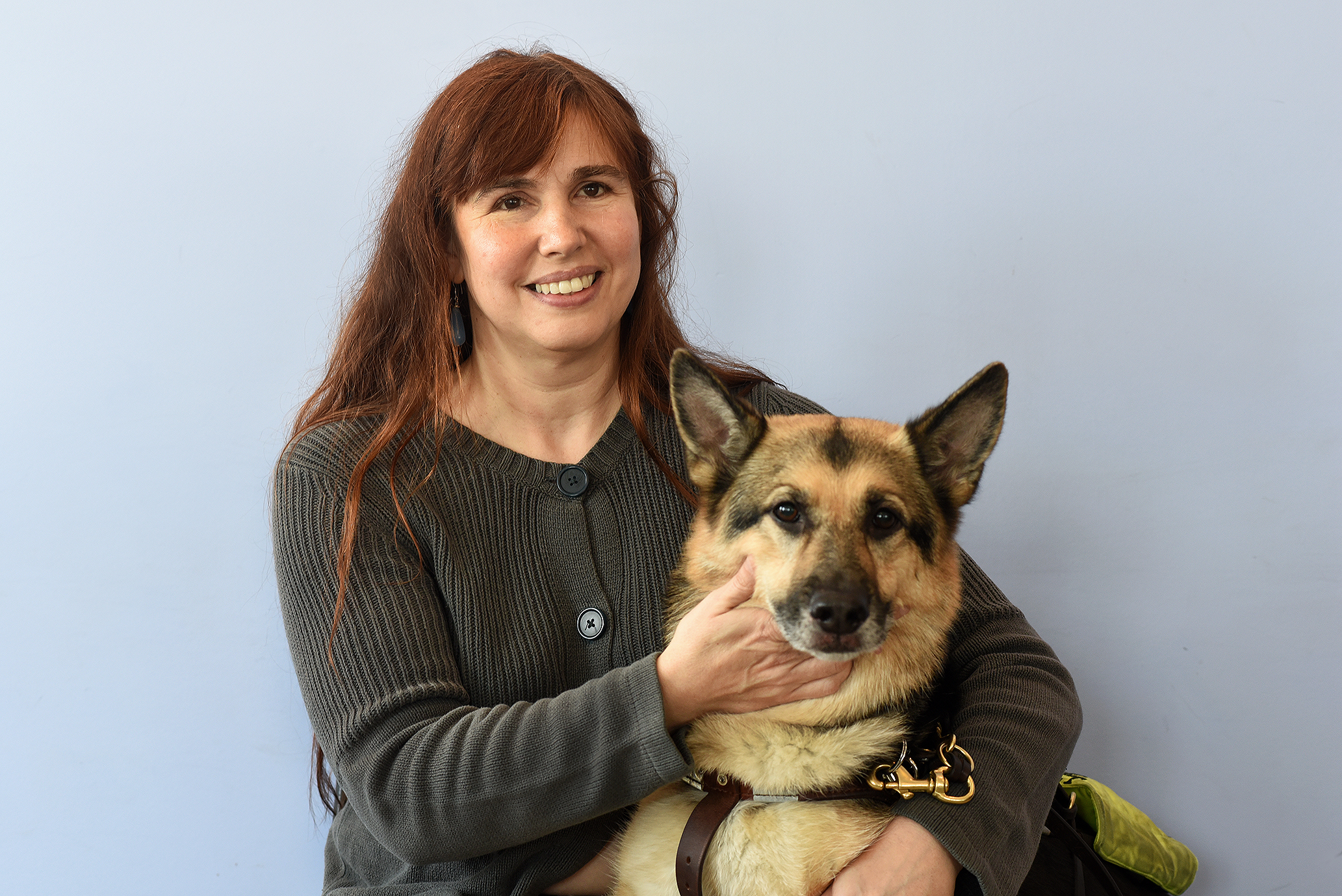
 This week, Darian Slayton Fleming, Certified Happiness Trainer & Licensed Clinical Social Worker talk to Sam and Charlene about her Podcast: Get What You Need And Feel Good About It. To get on our email list, receive weekly show updates, or offer feedback/guest suggestions, email [email protected]!